Overview
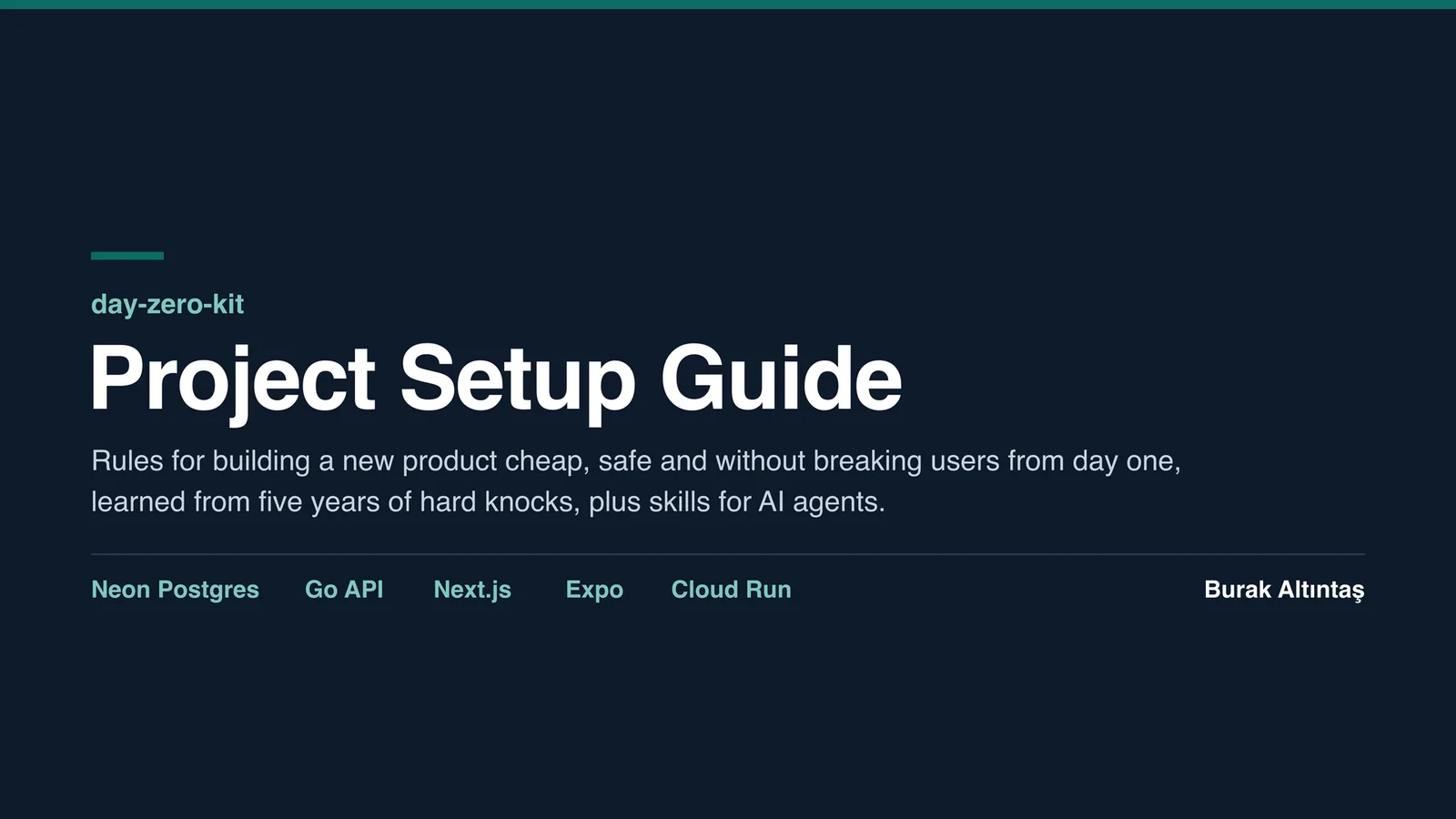
day-zero-kit is a Project Setup Guide and a set of eight skills for AI coding agents. It builds everything around a new product before its code is written: accounts, environments, budget alarms and spend limits, a bot door, alerts, backups, a mobile kit and project memory, all ready from day one. The team looks only at product flows while an agent sets up the infrastructure from the guide. The guide is written for Neon Postgres, a Go API on Cloud Run, Next.js and Expo.
Problem
The rules come from five years of building products and the knocks along the way: databases that never slept, paid APIs switched on with no cap, bots scraping a catalogue, credits that ran out without telling anyone, and users stuck on an old version who could not see a new flow.
Solution
I turned that experience into a guide with the numbers, then into skills an agent can follow. The agent asks the setup decisions one by one and records them in docs/DECISIONS.md, opens the project memory files and applies the setup plan phase by phase. It stops and asks the owner for anything only a person can do: accounts, payments, domains, store submissions, production deploys and anything public.
Results
From the bills and logs of my own live products, August to October 2026 (the guide calls them Product A–D):
- The monthly cloud bill went from about $80–90 in September to an estimated $27 (as of 8 October).
- Database compute fell from 6.5 to about 2.1 CU-hours a day: reads come from memory and the database sleeps.
- A maps API that cost about $31 a month went to $0 with open data and our own table.
- One scraper took 41% of web requests; the bot door refused 6,654 requests on its first day.
- A depleted API credit went unnoticed for 30 days; with alerting in place, error to alarm takes 4 minutes.
The Skills
project-setup: asks the decisions, opens the memory files and builds the infrastructure from day 0, phase by phase, and verifies it.decision-support: lays out options for paid APIs, plans, analytics, real-time delivery, OTA and region with real numbers.release-gate: runs the release gate before a store release or a production deploy and recommends ship or no-ship with evidence.cost-audit: a fix list for database wake-ups, instance caps, spend caps, quotas and build minutes.security-audit: findings on permissions, secrets, dependencies, reading other users' records, the bot door and KVKK.project-memory: keeps CHANGELOG, STATUS, TODO, DECISIONS and the handoff note up to date.alert-audit: checks that every error, credit, quota and expiry reaches the right person through the right channel.seo-geo-routine: runs SEO and GEO work, after first checking that bots do not wake the database.
Technical Highlights
- A Claude Code plugin marketplace with Turkish and English skill sets (
day-zero-kit-tr,day-zero-kit-en); the skills can also be used in Codex. - Every rule carries an evidence tag: proven in production, measured, or a recommendation.
- On every push, a Python check script verifies the manifests, the skills, that every reference file is an exact excerpt of the guide, and the links.
- The guide text is licensed CC BY 4.0; the skills and scripts are MIT.
Why It Matters
It turns expensive lessons into a repeatable day-0 setup: do not wake the database for nothing, put a cap and an alarm on every spend, leave no silent failure, run with least privilege, change without breaking users, and write down decisions and project memory.