Overview
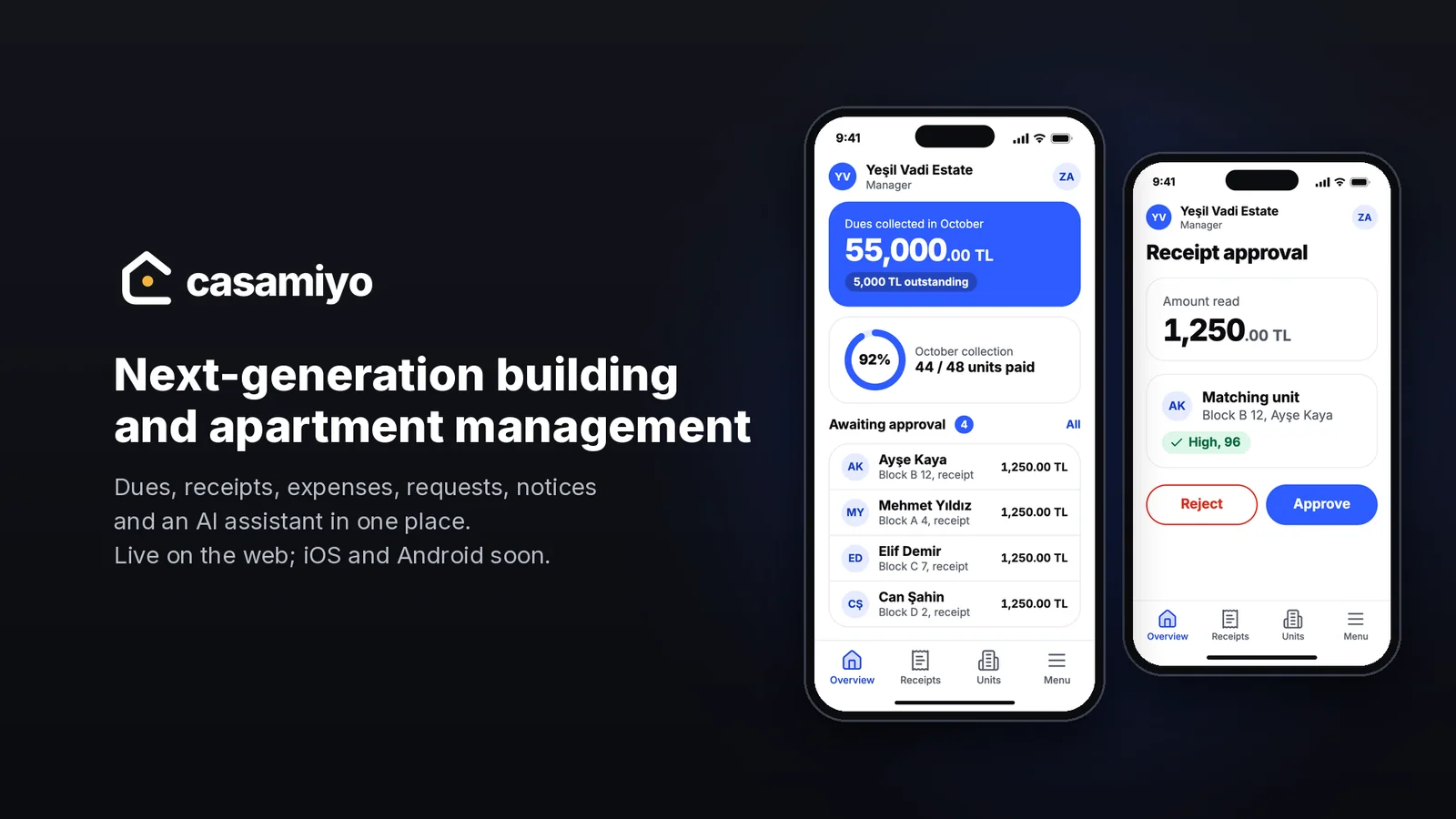
Casamiyo is a management app for apartment buildings and the multi-block complexes known in Turkish as "site". The manager, the management team (treasurer, auditor, accountant), owners and tenants all use the same app, and each of them sees their own screen. The site calls it "Next-generation building and apartment management".
It has been live on the web at casamiyo.com since 4 November 2026. The iOS and Android apps are coming soon.
Problem
In many Turkish buildings the books live in a paper ledger, an Excel file and a WhatsApp group. The manager is often a volunteer neighbour who does the job in the evenings. Residents pay their dues by bank transfer and send a receipt, and then someone has to match each payment to a unit, work out the late fee and explain where the money went. Posting the list of people in debt in a shared area is not an option either; the Turkish data protection board (KVKK) ruled it unlawful in decision 2026/348.
Solution
Casamiyo puts this work in one app and shows each role only its own part. An owner or tenant pays by bank transfer and uploads the receipt, the app reads the amount and the unit, and the manager approves it with one tap. Dues go straight into the building's own bank account and never pass through Casamiyo.
It costs 20 TL per unit a month, billed yearly. The first 3 months are free and no card is needed. Owners and tenants use it for free.
Key Features
- Dues and balances for every unit on one screen. The late fee of 5% a month under article 20 of the Condominium Law (Kat Mülkiyeti Kanunu) is calculated automatically.
- Receipt approval: AI reads the amount and the unit on an uploaded receipt, and the manager approves it or rejects it with a reason.
- Income and expenses with cash and bank balances. Residents see each month's income and expenses, with invoices, on a transparency page; only management sees the list of units in debt.
- Requests and repairs reported with photos and followed step by step.
- Notices that arrive as notifications, a building directory, and a listings board where neighbours post items for sale, lost things and services.
- Roles and permissions for the management team. The treasurer, auditor and accountant see only what they are allowed to, and every action goes into an audit log that cannot be deleted.
- Reports on collections, units in debt, and income and expenses, as PDF or Excel.
- An assistant that answers questions from the building's own documents and cites them.
- General assembly meetings with voting, a portfolio view for companies that run several buildings, common-area reservations, visitor pre-approval and a parcel log.
- Setup from an Excel file or a photo of the paper ledger. Invites go out by WhatsApp or SMS, with a QR poster for the entrance.
My Role
I built Casamiyo with a business partner. I lead the product and all of the engineering:
- Product scope, flows and design
- The Next.js web app and the Hono API
- The data model, with a separate database for each building
- The iOS and Android app in Expo
- The AI features and their spending caps
- Cloudflare infrastructure and releases
Technical Highlights
- An npm-workspaces monorepo in TypeScript: the web app, the API, the mobile app, and a shared package with the rules both clients use, such as navigation, dues calculation and building setup.
- Web: Next.js 16 and React 19 on Cloudflare Workers through OpenNext. The browser talks to a same-origin BFF, which forwards requests to the API Worker.
- API: Hono on Cloudflare Workers. People, memberships and subscriptions live in Cloudflare D1. Each building's ledger, dues, requests and audit log live in that building's own Durable Object with SQLite. Before settling on this, I tested one shared database, and an unfiltered query there returned another building's data.
- The building ID comes from the session on every query, and a record that does not exist returns the same 404 as one you are not allowed to see.
- Files are stored in Cloudflare R2, and all data stays in the EU.
- Mobile: Expo, React Native and expo-router, with layouts for phones, tablets and foldables.
- Sign-in with an email code, Google, Apple or a passkey. Email goes through Resend.
- AI: Anthropic's Claude Haiku reads receipts and runs the assistant. It is called only when someone taps a button, a suggestion counts only after the manager accepts it, and both steps are written to the audit log. Spending is capped per building each month and for the whole system each day. When a cap is reached, AI switches off and the rest of the app keeps working.
- An OpenAPI spec, personal API tokens and a read-only MCP endpoint.
Why It Matters
Casamiyo leaves the money in the building's own account and writes every payment and expense to a record the residents can check, so a question about the accounts has its answer on screen. Many residents are older, so the text is large, the buttons are wide, and joining from an invite link takes three steps.