Overview
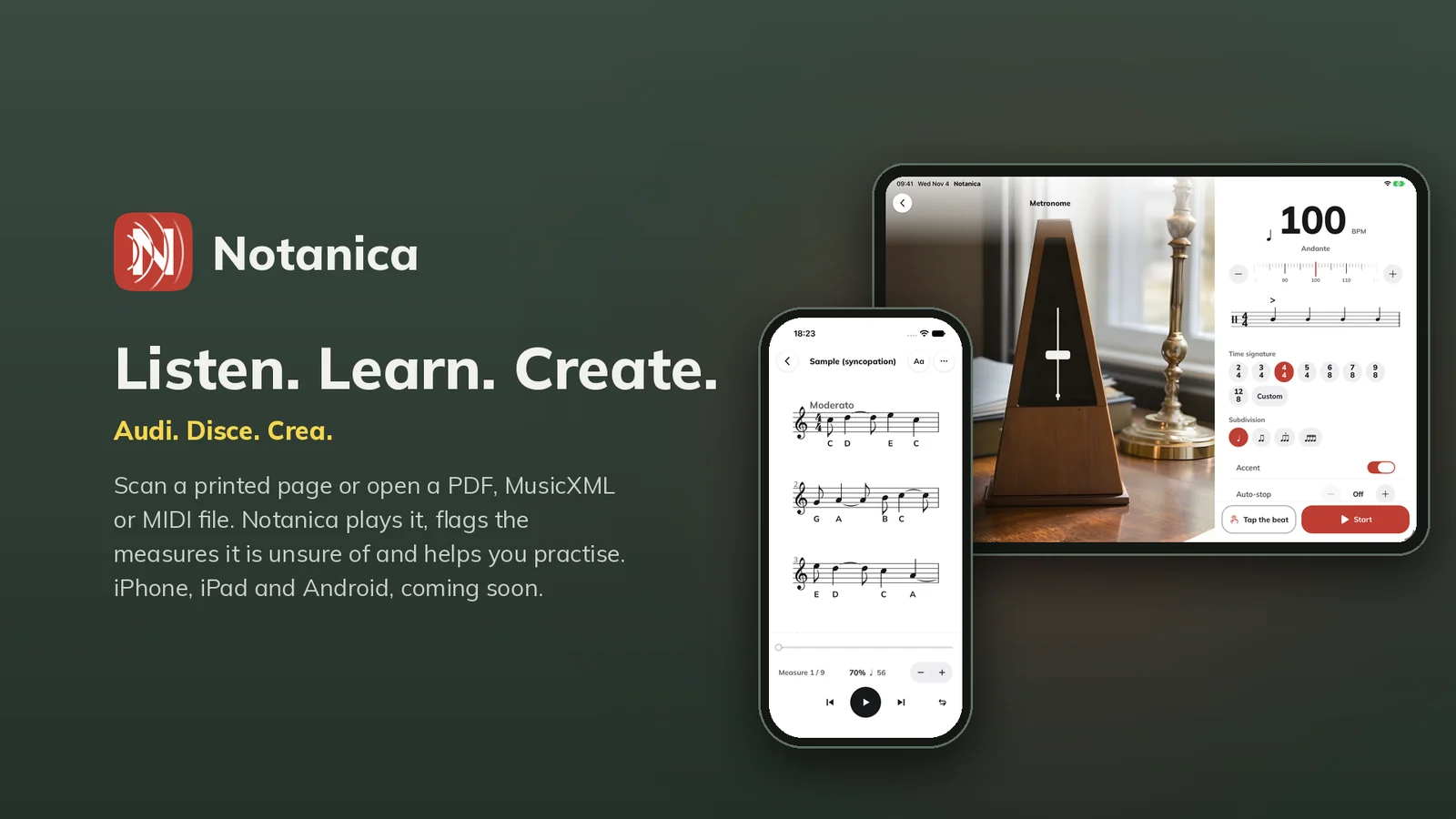
Notanica is a sheet-music app I am building for iPhone, iPad and Android. You photograph a printed page or open a PDF, MusicXML or MIDI file, and the app reads the notes and plays them. Around that sit tools to practise, learn and write music, and Turkish makam is built in. The motto is "Audi. Disce. Crea.", Latin for "Listen. Learn. Create."
The app is in development and coming soon.
Problem
A printed score makes no sound, so a student who cannot yet read a passage well has no way to hear how it goes at home. Software that reads sheet music from a photo makes mistakes, and when a misread note is played back with confidence, the student learns the wrong note. Makam is harder still, because recognition engines read its koma accidentals as ordinary sharps and flats.
Solution
Notanica reads the page, plays it and marks the measures it is unsure about. You check those measures against the printed page and tap a wrong note to fix it, and any change can be undone. Then you listen to the corrected score and practise with it.
Key Features
- Scan a printed page with the camera, pick a photo from the gallery, or open a PDF, MusicXML or MIDI file.
- Measures the app is unsure about are flagged for checking. Tap a note to correct it, and undo any change.
- Playback with tempo, an A-B loop, repeats and codas, and a count-in. Note names in your own system (C D E, do re mi or German H). Transposing instruments such as the clarinet, in written or concert pitch. Mute, solo or set the volume of each part, and play a simpler version of a hard passage.
- Practice tools: a metronome, a tuner with a 53-comma mode, a speed trainer and a practice plan with reminders.
- Lessons from reading the first notes up to chords and form, where each exercise checks your answer. Ear training with dictation, intervals and chords, and a timed exam.
- Compose by typing notes, add a second voice or a TAB staff, and export MusicXML, MIDI or PDF.
- Turkish makam: koma accidentals are written and played in 53-comma tuning, and the makam and usul are named at the top of the score.
- A child mode that a parent sets up. It reads exercises aloud, and the parent gets a weekly summary.
- For teachers: invite students, give each one a piece and follow their progress. In class, the score opens on a TV or any browser with a six-character code, and each group can get its own part.
- Seven languages: English, German, Spanish, French, Portuguese, Russian and Turkish.
My Role
I am the founder and sole owner of Notanica. I set the product, the scope and the design. I build it by directing AI coding agents, and five independent expert roles (a designer, a music teacher, a conservatory academic, a Turkish music expert and a software architect) review every step until no blocking issue is left.
Technical Highlights
- App: Expo SDK 58, React Native 0.88, Expo Router and TypeScript, on phones and tablets. Scores are drawn by OpenSheetMusicDisplay inside a WebView. Subscriptions run through RevenueCat.
- API: Go on Google Cloud Run, behind a Cloudflare edge Worker, with Neon Postgres and Cloudflare R2 storage in the EU. The edge Worker serves lesson and model downloads straight from R2, so those requests never wake the API or the database.
- Score reading: a Python music worker turns scanned pages into MusicXML. Two optical music recognition engines read every page, homr and a second engine as a second opinion, and measures where they disagree are flagged for the user.
- Each kind of score opens only after it passes its own accuracy threshold on held-out test pages. Until then the page stays an image, and the user is not turned away.
- Website: a static Next.js 16 site for Cloudflare, in all seven languages.
Why It Matters
Music students spend most of the week practising without their teacher. Notanica plays them the page in front of them and shows which measures to check. Makam players can read and hear their own repertoire with the koma in place.